


Vertical Steam Sterilizer Autoclaves are widely used in laboratories, medical institutions, food factories and other industries, relying on high-temperature and high-pressure saturated steam to complete thorough sterilization work. As a commonly used Sterilizer Vertical equipment, it has the advantages of stable performance, large capacity and convenient operation, but it will inevitably encounter various faults during long-term daily use. Most small problems can be solved by on-site maintenance without professional after-sales service, which can save time and ensure normal sterilization progress. Combined with daily operation and maintenance experience, this paper sorts out several common faults of vertical steam sterilizers and targeted repair methods.
1. Failure to Reach the Set Temperature and Pressure
This is one of the most common faults of Vertical Steam Sterilizer Autoclaves. The equipment runs normally, but the temperature and pressure in the chamber cannot rise to the set value, which directly leads to unqualified sterilization effect. The main reason for this problem is insufficient steam generation or poor airtightness.
First, check the heating tube of the Sterilizer Vertical. Long-term use will lead to scaling on the surface of the heating tube, which affects heat transfer efficiency and slows down steam production. At this time, the power supply should be cut off, and the scale on the surface of the heating tube should be cleaned with descaling agent regularly. If the heating tube is burned out, it needs to be replaced with a new matching heating tube in time.
Second, insufficient exhaust of cold air will also cause abnormal temperature and pressure. Before formal sterilization, the cold air in the chamber must be completely discharged, otherwise the residual cold air will reduce the actual temperature in the chamber. During operation, open the exhaust valve properly to let the cold air be fully discharged, and then close the exhaust valve to boost the pressure. In addition, check whether the exhaust valve is blocked by dirt, and clean the blockage in time to keep the exhaust smooth.

2. Air Leakage and Pressure Drop
Many Vertical Steam Sterilizer Autoclaves will have slow pressure drop during heat preservation, which is mostly caused by poor sealing. The sealing ring is a vulnerable part of the Sterilizer Vertical, and long-term high-temperature and high-pressure operation will cause aging, hardening and deformation, resulting in gaps and air leakage.
The first step is to check the silicone sealing ring at the tank cover. Clean the impurities and stains on the surface of the sealing ring and the sealing groove, and apply a small amount of high-temperature resistant lubricant appropriately to improve the sealing performance. If the sealing ring is obviously worn, cracked or aged, it must be replaced with a new sealing ring of the same model, which is the most thorough solution to air leakage.
In addition, check whether the safety valve, exhaust valve and pressure gauge interface are loose or damaged. Tighten the loose connectors in time, and replace the faulty valve parts if the valve core is worn or cannot be closed tightly. After maintenance, conduct a pressure test to confirm that there is no air leakage before formal use.
3. Abnormal Water Shortage and Water Leakage
Water shortage alarm of Vertical Steam Sterilizer Autoclaves is mostly caused by insufficient water addition or blocked water inlet pipeline. Before starting the machine, check the water level in the water tank to ensure that the water level is within the specified range, and use purified water or distilled water to reduce scaling. If the water shortage alarm is triggered frequently, check whether the water level sensor is covered by scale or faulty, clean the sensor surface or replace it in time.
Water leakage at the bottom of the Sterilizer Vertical is usually caused by damaged sealing gasket at the water discharge port or loose water discharge valve. Tighten the water discharge valve and check the aging degree of the sealing gasket. If the gasket is damaged, replace it with a new one. At the same time, avoid excessive force when closing the water discharge valve to prevent damage to the valve core.

4. Abnormal Noise and Unstable Operation
When the Vertical Steam Sterilizer Autoclaves is running, there is obvious abnormal noise, mostly from the heating part or the exhaust pipeline. Long-term use will lead to scale accumulation inside the heating chamber, resulting in uneven heating and vibration noise. Regular descaling and cleaning of the inner tank can effectively solve this problem.
In addition, unstable placement of the equipment will also cause vibration and noise during operation. Check whether the bottom support feet of the Sterilizer Vertical are balanced, adjust the support feet to keep the equipment stable, and avoid contact between the equipment and other hard objects to reduce resonance noise. If the noise comes from the internal fan or motor, it needs to be checked by professional maintenance personnel to avoid greater damage.
5. Control Panel Failure and Abnormal Alarm
The control panel of Vertical Steam Sterilizer Autoclaves may have button failure, display abnormality or false alarm. Most of these problems are caused by damp inside the control box or poor contact of lines. Keep the surrounding environment of the equipment dry and ventilated to avoid moisture entering the control box.
Check whether the wiring terminals are loose or oxidized, tighten the loose lines and clean the oxidized contacts. If the display screen is abnormal or the circuit board is damaged, it is recommended to contact professional after-sales personnel for replacement and maintenance, and do not disassemble the control components without permission.
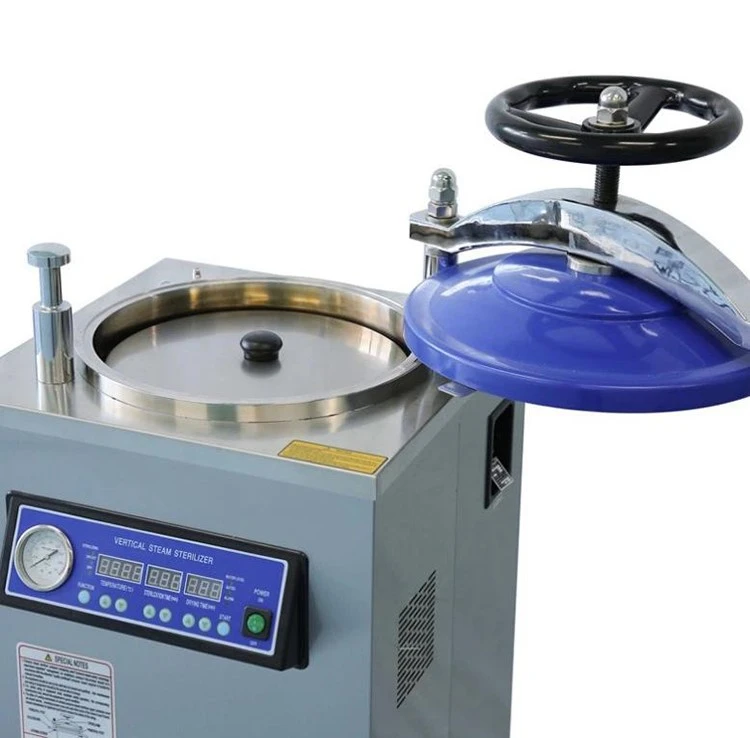
Daily Maintenance to Reduce Faults
For Vertical Steam Sterilizer Autoclaves, regular maintenance is far more important than emergency repair. After each use of the Sterilizer Vertical, clean the inner tank, drain the residual water, and keep the inside dry; regularly clean the sealing ring, heating tube and exhaust valve to prevent scaling and blockage; regularly check the performance of safety valves and pressure gauges to ensure flexible action. Proper daily maintenance can greatly reduce the failure rate and prolong the service life of the equipment.
In short, most faults of Vertical Steam Sterilizer Autoclaves are related to daily use and maintenance. As long as the cause of the problem is accurately found, targeted maintenance can be carried out quickly. For faults that cannot be solved by on-site treatment, do not force the operation, and contact professional maintenance personnel in time to ensure the safety and sterilization effect of the equipment.